
Blog · Learning & memory
The benefits of flashcards for studying
A flashcard is a double-sided card with a term/question on one side and the definition/answer on the other.
Flashcards work by prompting the user to retrieve information from memory, making it easier to recall again later. Answering the prompt before checking the back is called retrieval practice.
Checking your answers and repeating this process across spaced study sessions helps turn a moment of learning into more lasting knowledge.1

1. Remember more when you need it
Self-quizzing does more than check your knowledge: it can improve later recall. In experiments with short passages, Roediger and Karpicke found that students who practised retrieval remembered more after two days or a week than those who restudied. Rereading performed better after just five minutes, showing why immediate familiarity can be misleading.2
The benefit is knowledge you can bring to mind later, when the answer is no longer in front of you. To practise that skill, commit to an answer before looking, even if it takes some effort.
2. Keep knowledge for longer
Revisiting cards across separate sessions puts spaced practice to work. Cepeda and colleagues’ review found a broad advantage for distributed practice in verbal memory tasks. The most useful gap depended partly on how long people needed to retain the information.3
This makes a deck useful beyond the night before an exam. Return on later days, revisit difficult material sooner, and allow longer gaps as recall becomes reliable. There is no single ideal schedule for everyone.
3. Find gaps and correct mistakes
Trying to answer reveals what you can actually recall. Research on study habits highlights how familiarity can mislead judgements of learning.4 Use missed or incomplete answers to identify what needs more work, rather than judging progress by how familiar your notes look.
Checking answers also provides feedback. Butler and colleagues found that feedback improved later retention, including for correct answers people initially felt unsure about.5

4. Fit study into your day
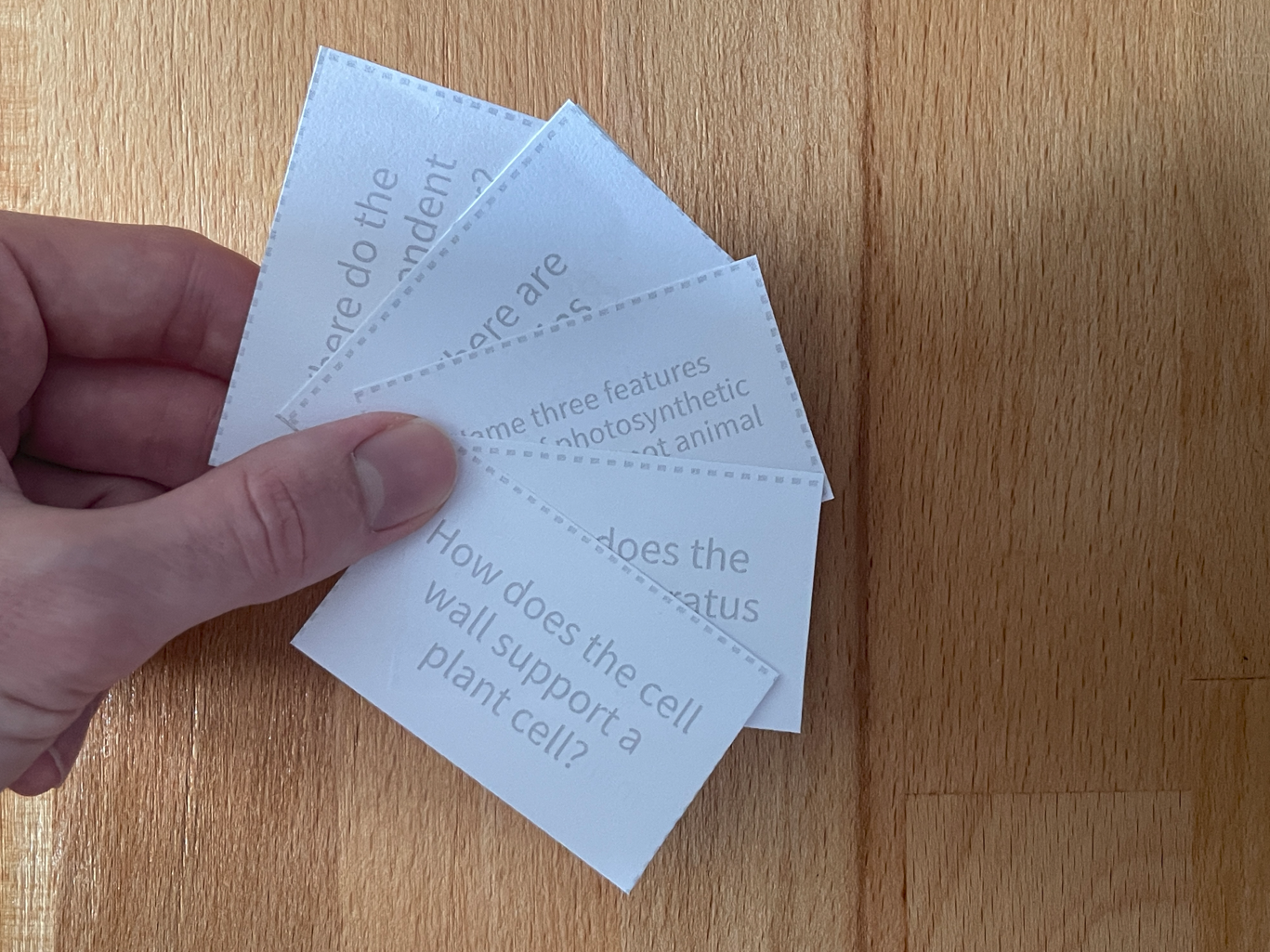
A small printed deck is easy to carry, sort into review piles, annotate, or share with someone who can quiz you. Once printed, it works without a screen or internet connection. These practical conveniences give you more ways to build retrieval practice into your routine.
Get more from your flashcards
- Try before looking. Say, write, or sketch an answer from memory.
- Check honestly. Notice missing details and correct mistakes.
- Return later. Keep reviewing across sessions, including cards you have answered correctly.
- Go beyond definitions. Ask yourself why something happens or how ideas connect.
Practice testing and spaced study have broad research support.1 For deeper understanding, combine cards with explanations, unfamiliar problems, and whatever practical work your subject requires.
References & footnotes
Scholarly sources supporting this article. Linked papers load only when you choose to visit them.
- Dunlosky, J., Rawson, K. A., Marsh, E. J., Nathan, M. J., & Willingham, D. T. (2013). Improving students’ learning with effective learning techniques: Promising directions from cognitive and educational psychology. Psychological Science in the Public Interest, 14(1), 4–58. View paper · doi:10.1177/1529100612453266 · ↩ 1st citation · ↩ 2nd citation
- Roediger, H. L., III, & Karpicke, J. D. (2006). Test-enhanced learning: Taking memory tests improves long-term retention. Psychological Science, 17(3), 249–255. View paper · doi:10.1111/j.1467-9280.2006.01693.x · ↩ Back to text
- Cepeda, N. J., Pashler, H., Vul, E., Wixted, J. T., & Rohrer, D. (2006). Distributed practice in verbal recall tasks: A review and quantitative synthesis. Psychological Bulletin, 132(3), 354–380. View paper · doi:10.1037/0033-2909.132.3.354 · ↩ Back to text
- Karpicke, J. D., Butler, A. C., & Roediger, H. L., III. (2009). Metacognitive strategies in student learning: Do students practise retrieval when they study on their own? Memory, 17(4), 471–479. View paper · doi:10.1080/09658210802647009 · ↩ Back to text
- Butler, A. C., Karpicke, J. D., & Roediger, H. L., III. (2008). Correcting a metacognitive error: Feedback increases retention of low-confidence correct responses. Journal of Experimental Psychology: Learning, Memory, and Cognition, 34(4), 918–928. View paper · doi:10.1037/0278-7393.34.4.918 · ↩ Back to text